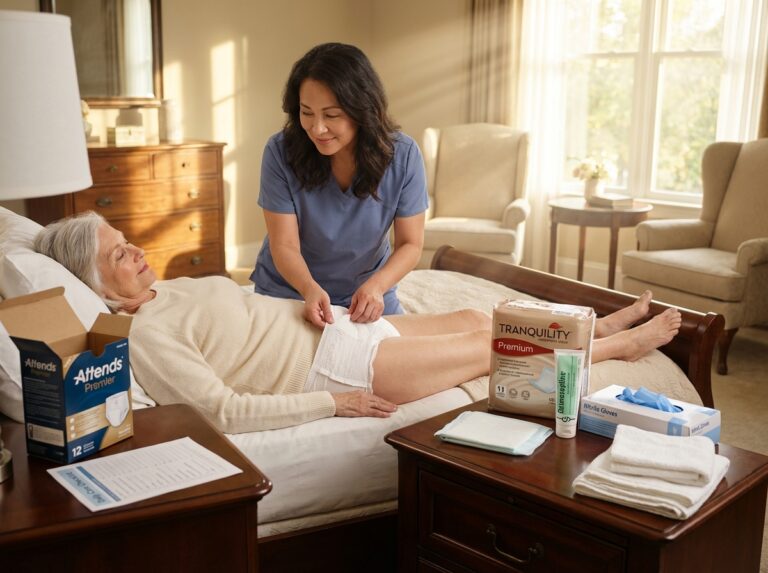
Caring for a bedbound senior with urinary incontinence raises tough choices about comfort, infection risk, and dignity. This article compares PureWick female external urinary systems and male external catheters with other options, explains when each fits, and gives practical bedside routines, monitoring tips, and decision checklists to help U.S. family caregivers make safe, person-centered choices at home.
Understanding Urinary Management Options for Bedbound Seniors
When a senior you love is bedbound, managing urinary incontinence becomes a central part of daily care. It’s a delicate balance of maintaining skin health, preventing infections, and preserving their dignity. The choices can feel overwhelming, but understanding each option is the first step toward finding the right fit. Let’s walk through the landscape of urinary management tools, from the simplest to the most complex.
Absorbent Products (Briefs and Underpads)
These are often the first line of defense. Adult briefs, or diapers, and disposable underpads work by absorbing urine to pull moisture away from the skin. They are widely available and relatively easy to use for mild to moderate incontinence. The main benefit is their simplicity and non-invasive nature. However, they have significant downsides. Even the most absorbent products can leave skin damp, increasing the risk for moisture-associated skin damage and pressure injuries. They require frequent changes, which can be disruptive, especially overnight. For the senior, constantly wearing a wet or soiled brief can feel undignified and uncomfortable.
Timed and Prompted Voiding
This behavioral approach involves creating a regular toileting schedule, perhaps every two to four hours. For seniors with cognitive challenges like dementia, prompted voiding adds verbal cues and assistance. This method empowers the senior and helps maintain normal bladder function. It’s an excellent, non-invasive option for those who have some mobility and awareness. The challenge is the high demand on caregiver time and consistency. It isn’t a practical solution for someone who is completely immobile or unable to sense the urge to urinate.
Indwelling and Suprapubic Catheters
These are internal catheters that drain urine continuously from the bladder. An indwelling urethral catheter, often called a Foley, is inserted through the urethra. A suprapubic catheter is inserted surgically through the abdomen directly into the bladder. Both keep the skin completely dry and reduce the caregiver’s workload for cleanups. They are necessary for managing urinary retention, a condition where the bladder cannot empty itself. But their use comes with a high risk of catheter-associated urinary tract infections (CAUTIs). They can also be uncomfortable and severely limit any potential for mobility.
Intermittent Catheterization
With this method, a catheter is inserted to drain the bladder and then immediately removed, typically every four to six hours. It significantly lowers the infection risk compared to an indwelling catheter because bacteria have less time to travel into the bladder. It’s a good option for people with urinary retention who have the necessary dexterity, or a caregiver who is trained and available for the regular schedule. For many family caregivers, the procedure can be intimidating and demanding to perform consistently at home.
Male External (Condom) Catheters
This is a less invasive option for men. A condom-like sheath is placed over the penis and connects to a collection bag. It keeps urine away from the skin without entering the body, which means a much lower risk of infection than internal catheters. It’s a great tool for men with incontinence but without urinary retention. The main drawbacks are potential leaks if the fit isn’t secure and the risk of skin irritation from the adhesive or friction.
Female External Urine Collection Systems
For a long time, there wasn’t a good external option for women. Systems like the PureWick™ System have changed that. This type of device uses a soft, flexible wick placed between the labia. It’s connected to a tube with low-pressure suction that pulls urine away into a collection canister. It is completely non-invasive and helps keep skin dry, reducing the risk of moisture-related skin breakdown. It’s designed for women who are bedbound or have very limited mobility. While it lowers the risk of CAUTIs associated with internal catheters, it’s not suitable for everyone. It requires intact skin and is not recommended in cases of frequent fecal incontinence due to the risk of contamination.
Choosing the right approach depends heavily on your senior’s specific situation. Someone with dementia who can still stand might benefit most from prompted voiding to preserve their abilities. For a person at high risk for pressure injuries, keeping their skin perfectly dry with an external system might be the top priority. If urinary retention is the problem, external devices are not an option; an intermittent or indwelling catheter will be medically necessary. The presence of fecal incontinence often makes absorbent briefs the most practical, albeit imperfect, choice. This decision should always be a conversation between you, your loved one, and their healthcare team to weigh the clinical needs against comfort and quality of life.
How PureWick and External Catheters Work and What Evidence Says
After exploring the different urinary management options, you might be wondering how external catheters actually work and what the data says about their effectiveness and safety. Understanding the mechanics and the evidence is key to deciding if one of these systems is a good fit for your loved one.
How the PureWick System for Women Works
The PureWick system is a noninvasive way to manage female urinary incontinence. It doesn’t go inside the body at all. Instead, it uses a soft, flexible wick made of a gauze-like material. This wick is gently placed between the labia, resting against the perineum where urine exits the body. The other end of the wick connects to a tube, which leads to a collection canister. A small, quiet pump provides low, continuous suction. When your senior urinates, the wick draws the urine away from the body, through the tubing, and into the sealed canister. Think of it as a tiny, gentle vacuum that keeps the skin dry.
The system has a few parts. The wick itself is a single-use, disposable item that should be changed at least every 8 to 12 hours, or whenever it’s soiled. The pump, tubing, and collection canister are reusable. Typically, the pump sits on a nightstand or the floor, and the canister is placed lower than the bed to help with drainage. Storing extra supplies is simple; the disposable wicks come in sealed packages and can be kept in a clean, dry place like a closet or drawer.
How Male External Catheters Work
For men, the most common external device is the condom catheter. It functions much like its name suggests. It’s a flexible sheath, similar to a condom, that is rolled over the penis. Most modern versions have a gentle adhesive on the inside to create a secure seal against the skin and prevent leaks. A small port at the tip of the sheath connects to tubing, which drains urine into a collection bag. This bag can be a smaller one strapped to the leg for mobility or a larger bedside bag for use overnight. Like the PureWick wick, the catheter sheath is a single-use product. The collection bags are often reusable for several days to a week, depending on the manufacturer’s instructions, and should be cleaned regularly.
What the Evidence and Experience Tell Us
The primary benefit of any external catheter is avoiding an indwelling (Foley) catheter. Indwelling catheters are a major source of urinary tract infections in healthcare settings. By keeping the device outside the body, external systems may help reduce this risk. This is a significant reason why PureWick has become widely adopted in hospitals. However, the data isn’t perfect, and these devices have their own set of challenges.
The most common issue is skin irritation. For male catheters, the adhesive can cause redness or breakdown. For the PureWick system, improper placement or suction that is too high can lead to perineal skin irritation or even pressure injuries. An analysis of the FDA’s adverse event database from 2017 to late 2023 found that of the 1,406 complications reported for the PureWick, about 68% were patient injuries, mostly related to skin issues. This highlights the importance of proper technique and regular skin checks, which we’ll cover in the next section. It’s crucial to remember that while these devices can be very helpful, they require careful management and are not without risk. Local clinical judgment from your senior’s doctor or nurse is essential.
Who Is a Good Candidate?
These devices are not a one-size-fits-all solution. Patient selection is critical for success.
- The PureWick system is generally best for women who are bedbound or have very limited mobility. The user needs to have intact perineal anatomy so the wick can be positioned correctly. It is designed for incontinence, not for urinary retention (the inability to empty the bladder).
- Male external catheters are suitable for men who do not have urinary retention and have enough penile length and intact skin for the sheath to be applied securely. Severe retraction or skin breakdown on the penis would make this option inappropriate.
In some situations, other methods remain necessary. If your senior has urinary retention, an intermittent or indwelling catheter is required to drain the bladder. After certain pelvic surgeries, a doctor may advise against using any external device until the area has healed. Also, these devices are not recommended for individuals with severe, unmanaged fecal incontinence, as the risk of contamination and infection is too high. Always consult with your senior’s healthcare provider to determine the most appropriate choice.
Assessing Suitability and Practical Bedside Care Routines
Deciding to use an external urinary device is a significant step, and it’s one that requires careful thought. It’s not just about managing incontinence; it’s about finding the right tool that fits your senior’s specific needs, your capabilities as a caregiver, and your shared goals for comfort and health. Before you begin, a thorough assessment can help you determine if a device like the PureWick™ System or a male external catheter is the right choice. Consider planning a 3 to 7-day trial period, perhaps on a weekend when you have extra help, to assess fit, comfort, and effectiveness without pressure.
Here is a practical checklist to guide your decision-making process with the clinical team.
-
Medical Indications.
The primary reason for using these devices is urinary incontinence, not urinary retention (the inability to empty the bladder). If your loved one cannot urinate on their own, an external device will not help and an indwelling or intermittent catheter is likely necessary. A clinician can confirm this, sometimes with a quick bladder scan to measure post-void residual (PVR) urine. -
Skin Integrity and Anatomy.
The skin where the device will sit must be intact. Check for open sores, rashes, or severe irritation. For a PureWick, the female anatomy needs to have labia that can hold the soft wick in place. For a male external catheter, there must be enough penile length and intact skin for the sheath to adhere securely without causing constriction. -
Cognitive and Mobility Status.
These devices are designed for individuals who are bedbound or have very limited mobility. For a male external catheter, a person who is confused and agitated may try to pull it off, making it less suitable. The PureWick system is often a good option for women regardless of their cognitive status because it is positioned externally and held in place by their body and undergarments. -
Urinary and Bowel Patterns.
Frequent, uncontrolled bowel movements can contaminate a PureWick device, making it ineffective and increasing the risk of infection. If fecal incontinence is severe, this may not be the right solution. However, for urinary incontinence alone, it can be very effective. -
Caregiver Capacity and Home Environment.
Be realistic about your ability to manage the device. It requires daily checks, cleaning, and changes. You’ll need a clean, dry space to store supplies and a layout that allows you to manage tubing without creating a trip hazard. The system itself is straightforward; manufacturer surveys suggest over 90% of caregivers find the PureWick™ System easy to set up.
Once you and the clinical team decide to proceed, establishing a consistent bedside routine is the key to success.
Your Daily Care and Monitoring Plan
Gather Your Supplies.
Before starting, have everything within reach: a new external catheter or wick, disposable gloves, a basin of warm water, a gentle perineal cleanser (pH-balanced), soft cloths, a moisture barrier cream (dimethicone or zinc oxide-based), and a clean collection canister or leg bag if needed.
Placement and Positioning.
For PureWick: After cleaning and thoroughly drying the perineal area, gently separate the labia and place the soft gauze wick between the labia minora, ensuring the top of the wick is aligned with the pubic bone. Tuck it securely but comfortably. The device should not be inserted into the vagina or anus.
For Male External Catheters: After cleaning and drying, roll the catheter sheath smoothly onto the penis, leaving a small space at the tip to prevent irritation. Gently press the adhesive area to ensure a good seal without any wrinkles.
System Checks and Management.
With the PureWick, ensure the suction is on (you should hear a quiet hum) and the tubing is straight, without kinks, and positioned below your loved one to allow for gravity drainage. For male catheters, secure the tubing to the thigh with a strap and ensure the collection bag is below the bladder level, whether it’s a leg bag or a larger bedside bag.
Routine Changes and Cleaning.
Change the PureWick wick every 8 to 12 hours, or immediately if it becomes soiled with stool. Male external catheters are typically changed daily. Empty the collection canister or bag when it is about two-thirds full. At every change, perform a thorough skin inspection. Cleanse the entire perineal area gently, pat it completely dry, and apply a thin layer of barrier cream to the surrounding skin to protect it from moisture.
Turning and Repositioning.
Continue to turn and reposition your senior at least every two hours. This is vital for preventing pressure injuries and helps ensure urine doesn’t pool around the device, which could cause leaks or skin irritation.
Monitoring for Problems.
Stay vigilant for signs of trouble.
- Infection: Look for cloudy, dark, or foul-smelling urine; fever; or new confusion.
- Blockage: If no urine has collected for several hours, check for kinks in the tubing or device displacement.
- Skin Breakdown: At the first sign of persistent redness, blisters, or broken skin, stop using the device. While studies show high user satisfaction, reports to the FDA have noted skin irritation as a potential adverse event.
If you notice any of these signs, discontinue use and contact your clinician immediately. Maintaining dignity is paramount. Always explain what you are doing, use a cover sheet to ensure privacy, and speak with respect. Proper waste disposal, consistent hand hygiene, and safe storage of supplies are non-negotiable parts of a safe home care routine.
Documenting and Advocating for Your Senior
When problems arise, clear information helps your clinical team make the best decisions. Keep a simple log noting the date, the specific issue (e.g., “leak from left side,” “red patch on right buttock”), and what you did about it. A smartphone picture is incredibly powerful. Take one from a slight distance to show the location on the body, and then a clear, well-lit close-up of the skin issue. When you call the doctor or nurse, lead with a clear summary: “We’re using the PureWick and I’m concerned about skin breakdown. I have a photo and a log I can email you. Can we discuss if we should continue?” This proactive, evidence-based approach makes you an effective advocate for your senior’s comfort and safety.
Frequently Asked Questions
As a caregiver, you’ll find that many of the same questions come up day after day. This is especially true when using new equipment like external urinary catheters. This FAQ provides quick, reliable answers to the most common operational and safety concerns you’ll face at the bedside, helping you troubleshoot in the moment.
Are these devices safe for my elderly parent?
For the right person, yes. External catheters are non-invasive, which significantly reduces the internal risks of traditional catheters. However, safety depends on proper use. The biggest risks are skin irritation and breakdown. An analysis of FDA adverse event reports highlighted that most complications were related to skin injuries. They are not safe for seniors with urinary retention, as they do not drain the bladder, or for those with broken skin in the perineal area.
Practical Action: Before starting, confirm with a clinician that your parent is a suitable candidate, specifically asking about urinary retention and skin integrity.
Is the PureWick painful?
It should not be. The PureWick female external catheter is made from a soft, flexible material, and the system uses very low-pressure suction. If your loved one expresses pain, it’s a sign that something is wrong, often improper placement or pre-existing skin irritation. Surveys conducted by the manufacturer show that over 80% of users find the system comfortable.
Practical Action: Remove the device immediately if pain is reported. Gently cleanse and inspect the skin for any redness or broken areas. Allow the skin to air out before attempting to reposition the device.
How often do I need to change the parts?
This is a critical routine for hygiene and function. A good rule of thumb is:
- PureWick Female Catheter (the wick): Change every 8 to 12 hours, or immediately if soiled with stool.
- Male External Catheter (the sheath): Change every 24 hours.
- Tubing and Collection Canister: Change weekly, or per your medical supply company’s instructions.
Practical Action: Use a small dry-erase board in the room to track the date and time of the last change for each component.
What if the device leaks?
Leaks are a common frustration. For the PureWick, the primary cause is improper placement; the wick must be tucked snugly between the labia. For male external catheters, leaks often happen because the wrong size is being used or the skin was not completely dry before application, preventing a good seal.
Practical Action: If a leak occurs, remove the device, clean and dry your senior thoroughly, and reapply, paying close attention to fit and placement. Always use a high-quality absorbent underpad as a backup.
How do these devices affect UTI risk?
Compared to indwelling (Foley) catheters, external systems generally lower the risk of catheter-associated urinary tract infections (CAUTIs) because they do not enter the sterile urinary tract. However, the risk is not zero. Poor hygiene can still introduce bacteria to the urethra.
Practical Action: Strict handwashing before and after handling the device is non-negotiable. Follow a consistent perineal cleansing routine at every change.
Can I use them with bowel incontinence?
This is a major safety concern. The PureWick system is generally not recommended for individuals with frequent, uncontained bowel incontinence due to the high risk of contamination and UTI. Male external catheters are less risky in this scenario, but the area must still be cleaned immediately after any bowel movement.
Practical Action: If your senior has co-occurring bowel incontinence, discuss this specifically with their doctor. A combination of barrier creams and absorbent briefs may be a safer alternative.
Are they covered by Medicare or insurance?
Coverage varies. Medicare Part B often covers external catheters under its durable medical equipment (DME) benefit, but it requires a doctor’s prescription and a diagnosis showing it is medically necessary. Private insurance plans have their own rules.
Practical Action: Contact a DME supplier. They can take the prescription and insurance information and verify coverage for you, explaining any out-of-pocket costs.
Can I use them after surgery?
You must get clearance from the surgeon first. These devices should never be used over fresh incisions, stitches, staples, or drains in the genital or perineal area, as this could disrupt healing and cause a serious infection.
Practical Action: Ask the surgical team for specific instructions on incontinence management during the recovery period.
How can I prevent skin breakdown?
Prevention is key. Follow a consistent routine:
- Inspect the skin under good lighting at every device change.
- Cleanse with a gentle, pH-balanced wash.
- Pat the area completely dry—do not rub.
- Apply a thin layer of a zinc-oxide-based moisture barrier cream.
- Continue your regular schedule of turning and repositioning.
Practical Action: If you see a red area that doesn’t fade after 30 minutes, leave the device off to let the skin recover. If you see a blister or open sore, contact a wound care nurse or the primary doctor.
What supplies should I keep on hand?
Being prepared prevents emergencies. A good weekly stock includes:
- A 7-day supply of catheters (e.g., 14 PureWicks or 7 male catheters)
- A large box of disposable gloves
- Perineal cleanser and soft washcloths or disposable wipes
- Moisture barrier ointment
- Absorbent underpads
- One spare set of tubing and a collection canister
Practical Action: Ask your DME supplier about setting up automatic monthly or bi-monthly deliveries so you never run low.
How do I troubleshoot suction, fit, or odor?
- Suction (PureWick): If you don’t hear a faint hum, check for kinked tubing, a loose canister lid, or a wet filter that needs replacing.
- Fit: For male catheters, use the manufacturer’s measurement guide. For PureWick, proper placement is critical; watch videos on the official PureWick™ site to see the technique.
- Odor: A strong, foul odor from the urine can be a sign of a UTI or dehydration. If the canister itself smells, it needs more frequent cleaning or replacement.
Practical Action: If you suspect a UTI (odor, cloudy urine, fever), stop using the device and call the doctor immediately.
When should I switch to an indwelling catheter or consult a clinician?
It’s time to re-evaluate with a healthcare professional if you experience:
- Persistent skin breakdown that does not heal.
- Constant, unmanageable leaks.
- Signs of urinary retention (no urination in over 8 hours, or a firm lower belly).
- Recurrent UTIs despite proper hygiene.
Practical Action: This is not a failure; it simply means your loved one’s needs have changed. A clinician can assess if another management strategy is now more appropriate.
Final Recommendations and Decision Checklist
Deciding on an external urinary management system is a significant step that balances potential benefits with practical realities. After exploring the options, the final choice comes down to your senior’s specific needs, your capacity as a caregiver, and close collaboration with their healthcare team. These devices are not a one-size-fits-all solution. They are tools that, when used correctly for the right person, can dramatically improve skin health, reduce the burden of constant brief changes, and restore a measure of dignity.
Working with Your Team and Moving Forward
The first, non-negotiable step is to confirm clinical suitability with a doctor or nurse. They must verify that your senior does not have urinary retention and has intact skin, making them a safe candidate for an external device. Your senior’s primary care provider is your starting point, but don’t hesitate to involve specialists. A urologist can investigate underlying urinary issues, while a wound care nurse is an invaluable resource for preventing and treating skin complications. Home health nurses are your frontline partners for training and troubleshooting.
When you begin a trial, have the contact number for the device manufacturer or your medical supply company handy. They can often help with basic operational questions. If the device isn’t working well after several days of adjustments, don’t feel defeated. It simply may not be the right tool for your loved one’s unique anatomy or situation.
Ultimately, managing incontinence for a bedbound senior is about choosing the option that best supports their safety, comfort, and dignity. External catheters can be a wonderful alternative to indwelling catheters and absorbent briefs, but they require diligence. Set realistic expectations; occasional leaks may still happen. The goal is a significant improvement, not flawless perfection. To get started, discuss the suitability checklist with your senior’s doctor and then contact a durable medical equipment (DME) supplier to inquire about insurance coverage and ordering supplies.
References
- The BD PureWick™ System – Official Site — #1. PureWickTM is the #1 external catheter brand used in hospitals Based on US Medical Supply Distribution Data as of 2024. · 55 million+. PureWickTM …
- BD Expands PureWick™ Portfolio with First-of-its-Kind Portable … — To date, more than 55 million PureWick™ External Catheters have been sold, and over 4,500 hospitals and rehabilitation facilities across the …
- Global External Catheter Market – Size, Share, and Forecast (2025 … — The global External Catheter market size reached US$ 1.69 Billion in 2024 and is expected to reach US$ 2.82 Billion by 2033, growing at a CAGR …
- ICS 2024 Abstract #645 A comparative study of the efficacy and … — ICS 2024 Abstract #645 A comparative study of the efficacy and comfort of the Purewick™ male external catheter in healthy volunteers.
- MP23-13 FEMALE EXTERNAL CATHETER FOR MANAGING … — INTRODUCTION AND OBJECTIVE: Purewick® External Catheter, the first female external urinary catheter (EUC), was introduced in 2016.
- Adverse Events Associated With Female External Urinary Collection … — There are adverse events associated with the PureWick external urinary collection device in reports from the US Food and Drug Administration database.
- An Evaluation of the PureWick™ Male External Catheter Versus an … — This post-market study will assess the performance of and user satisfaction with the PureWick™ Male External Catheter in a home setting.
Legal Disclaimers & Brand Notices
This content is provided for informational purposes only and is not intended to be a substitute for professional medical advice, diagnosis, or treatment. Always seek the advice of a qualified healthcare provider with any questions you may have regarding a medical condition, the use of specific medical devices, or changes to a care plan. Never disregard professional medical advice or delay seeking it because of something you have read in this article.
All product names, logos, and brands mentioned in this article, including but not limited to PureWick™ and PureWick®, are the property of their respective owners. The use of these names, logos, and brands does not imply endorsement or affiliation unless explicitly stated.